Showing posts with label weaving books. Show all posts

I deleted my last post and wrote about krokbragd instead!

I had a long post, all ready to go. It was a little bit of weaving and a LOT of life. I'm glad I didn't hit "publish" on that post right away. I'll explain...

The post was written at the end of a really busy week. I had launched a new class for my Online Weaving School, I had made a Youtube video, I had promoted the new class everywhere I could think of to promote it, I had homeschooled the kids and cared for my family, we had been on educational outings, appointments and activities. Yeh, I was pretty tired at the end of that week. And then I sat down to write a blog post.

A little bit of advice to you all - don't write blog posts when you're over tired. And if you do write them, don't publish them! That's all I'll say on the subject for now, except to add that I have now caught up on some much needed sleep and rest and am thankful that, not only did I get over my little self pity party, but also that I decided not to inflict my Whingefest upon your eyes and minds!

Now, let's get to the fun stuff.

I had been wanting to warp up my inkle loom for quite some time, as it has been sadly neglected and I do so enjoy weaving on it, just for something a bit different. My loom is the Ashford Inkle, which is the larger version, they also make the Inklette, which is more petite for smaller and narrower bands.

I didn't know what to warp up, so I took a flick through my go - to Inkle book, The Weaver's Pattern Directory by Anne Dixon. I often recommend Anne's Handweaver's Pattern Directory  for 4 shafts, as it is so packed with drafts and quality information and her inkle book is no exception. 


I started by picking out some colours from my stash that I love (always a good way to start a project, even if you're not that confident with colour choices). I ended up with a mixture of mercerised and unmercerised 8/2 cottons. If you're unfamiliar with 8/2 cottons I often use Maurice Brassard as they are great quality and come in heaps of colours. Here is an example of MB 8/2 unmercerised. A comment from Gai has just reminded me of something I wanted to add about mercerised cotton. In general, I don't like to use it on a larger loom, it twists up on itself and is a general pain in the neck. However, on the Inkle loom it's different. Because you warp directly on to the pegs without having to do extra threading or moving of the warp, it behaves itself very well. It is constantly under high tension, so is easy to use and does add a lovely "gleam" to the project.

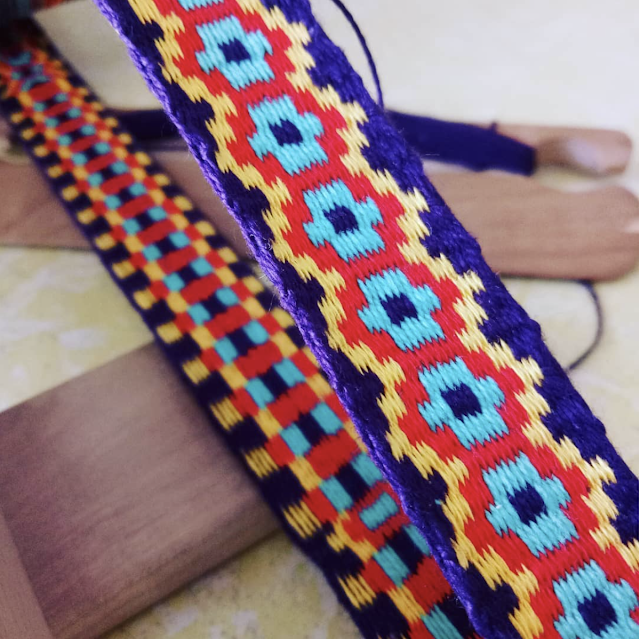
Being the lover of the weave structure Krokbragd that I am, it was a natural choice. Did you know you can weave krokbragd on an inkle loom? Yes, you totally can!


And, did you know that a krokbragd band is as equally gorgeous as a larger loom project? Yes, it totally is!  

So now I'm really excited about the design possibilities for this, though I admit that the design aspect is different to what I'm accustomed to -  it's proving quite a challenge for me and is a bit to get my head around. I'll keep plugging away at it though, and I'm sure I'll get there.


I love that the reverse side is just as striking as the front.

As soon as I posted these on social media, people were asking me for a class, which I would love to do once I have some of my own designs up and running. In the meantime, if you have Anne's book or are interested in purchasing (perhaps your library might have it?) this krokbragd design is from page 107.

And, if krokbragd band weaving is of interest to you, there will definitely be more to come!

Thanks for reading, until next time...

Happy Weaving!

*Please note - this post contains affiliate links, meaning that if you click and purchase, I will receive a small percentage of the sale. I only recommend products that I own and love.


Great rigid heddle weaving books!

My last post detailed some of my favourite books for 4 shafts or more, but today I'd like to talk about some great rigid heddle books.
I already have a video on this topic, but I know some people prefer to read rather than watch, plus I've added some extra books to the original list, so here we go!


*this post contains affiliate links. This means that if you click on the book link provided and purchase the book, I will receive a small commission.

I'll start with my favourite and most used book, in fact, this is the first rigid heddle weaving book I bought.

The Weaver's Idea Book by Jane Patrick This book has so much content and is great for beginners. It allows you to start with the basics and build as you go. Just about everything you need to know initially is contained within these pages and I think of it a little like a training ground for new weavers. It is also hardcover with spiral binding, making it easy to lay flat and view while you're weaving. Highly recommended!

Weaving made Easy by Liz Gipson. A lovely little book that includes information on loom set up. The projects are simple enough for beginners and interesting enough for all weavers.

Woven to Wear by Marilyn Murphy. I also read this book as a newer weaver and loved how it stirred my imagination. It contains simple garments with lots of plain weave, making it great for beginners, particularly those wanting to get a taste for sewing with your handwoven. The sewing projects are simple rather than finicky, with the use of large shapes instead of small pieces.

Inventive Weaving on a Little Loom by Syne Mitchell This book is awesome value for beginners to intermediate with lots of ideas. For the newer weaver, there is practical information and plenty of inspiration for once you have the basics down. I think of this book as one that you may not fully appreciate until you have some more weaving experience, perhaps a book that will grow with you through your weaving journey. Towards the middle and later part of the book are projects and ideas that may be too challenging for a new weaver, but that an enthusiastic and curious weaver will definitely want to make use of later on. There is a lot of information, it is attractively set out and a joy to flip through.

Weave, Knit, Wear by Judith Shangold  This book is responsible for opening my eyes and quickening my heart over the range of possibilities with a rigid heddle loom and garment making. Judith uses mostly plain weave, colour and design to make fabric look special. She includes design layouts and illustrations to help you wrap your head around how garments can be constructed. What I really love about this book is the fusion of weaving, knitting and crochet added in. It really has encouraged me to think outside the square and maximise my rigid heddle loom.

Simple Woven Garments by Sara Goldberg Another really great book on making simple garments with simple, colourful, hand woven cloth. There are more than 20 projects and they are all wearable! There are also details on adjusting garments to your own specifications.

I hope you enjoyed my list and until next time...

Happy Weaving!

My Favourite Books for Multi Shaft Weaving

I love books, so it makes sense that I am a huge lover of good weaving books. It can be hard to know which books are worth buying, especially if you're buying online and can't view the book before purchase.

I have already made a video on my favourite rigid heddle weaving books, but haven't talked about my floor loom or multi shaft books.

This is certainly not an exhaustive list, and I definitely plan on increasing my collection over the years, but these are a few that I have found particularly good.

*Disclaimer* This post contains some affiliate links, which means if you click on a link I've provided and purchase a book, I get a small commission from The Book Depository. These are all books that I owned and loved before becoming an affiliate, and I would not recommend a book I did not own and use.

I will start with my absolute favourite. If, in some terrible circumstance, I had to choose just one of the following books to keep, this one would be it!


The Handweaver's Pattern Directory by Anne Dixon only covers 4 shaft weaves, and yet, with the number of pattern drafts you could feasibly use this book for years before even considering buying an 8 shaft book. There is nothing I do not love about this book! Yes, it is a little expensive, but I consider  it my "go to" for any 4 shaft weaving. It's a hardcover book with spiral binding. This is awesome because you can lay the book flat to follow a threading or treadling pattern, and the hard cover prevents any damage to the pages. I've had mine for many years and it still looks as good as new. The layout shows you exactly what you can expect from each draft by providing colour pictures and yarns used to achieve each one - great for those just starting out.


Once again, not a cheap book, but this one is an absolute classic!  Carol Strickler's A Weaver's Book of 8 Shaft Patterns has plenty of information on 8 shaft weaves, explanations of tie ups and treadlings, and black and white pictoral representations of each weave (there are almost 900 photos). Individual yarn suggestions are not given, but in each new chapter, suggestions are made for particular weave structures. Many of the drafts have historical information - where the draft came from (if known) or where it is adapted from, which provides the keen weaver the opportunity for further research if desired. 


Next Steps in Weaving by Patty Graver has been a great one to add to my library. Published in 2015, it has a more modern and fresh feel. The layout is uncluttered but still contains a lot of information. I admit that I read this book when it first came out and I was in the infancy of my multi shaft journey. I felt like some of it was a bit beyond me at the time. However, when I cam back to it later (after a lot of research and practice) I found that the language now made sense and it was in fact a very helpful book! 
The beginning of the book goes over understanding terminology and drafts (something that many new weavers struggle with!) She explains twills and twill orders and then launches straight into the projects. This is my style of learning and teaching - project based! To get stuck in and actually learn something as you do it, rather than be stuck at the starting line with a lot of theory and fear of how to put it into practice. Patty starts with some basic twill projects, then shows more advanced versions to expose the reader to what is possible with variations and colour. The threading charts for the projects are all colour coded, which I think is a really great visual learning cue for newer weavers, and even for more seasoned weavers who just want to follow a threading chart in a simple format.
There is a lot more I could say about this book, but then this post may turn into a book itself! So, I'll finish up with this. It's a great book, the projects and samples are beautiful and inspiring, and even if, like me, you find it a little overwhelming to begin with, it is a book you can keep going back to over and over.


A Handweaver's Pattern Book by Marguerite P Davison is another well know weaver's classic. It was first published in 1944 as a green book, the orange one being a more recent and updated publication. I have heard that the original green book was better, but being out of print for some time, is as rare as hen's teeth. This book has 200 pattern drafts and has 4, 6 and 8 shaft weaves. The layout is a little more old fashioned (though there are black and white photo representations of most drafts) and some may find it difficult to decipher the way in which the drafts are drawn. That should not put off the adventurous weaver though, as it is very beneficial to be able to read all styles of drafts so that you can decipher them, no matter what country or time period they are from.


This is one of those books that you read and just think, "that is a lovely little book". Simple, lovely big photos, nice colour. Tom Knisely's Handwoven Baby Blankets starts out with a useful section on the basics of baby blanket weaving, such as sizes, colours and materials. 
There are over 30 projects and it includes both 4 and 8 shaft. Every project has specific yarn and colour descriptions. If you're interested in weaving baby blankets, I highly recommend this delightful book!


Probably my most asked question from multi shaft weavers is "how do I read a draft?" The next step on from understanding how to read and use a weaving draft is to begin drafting them yourself. This is something that is of huge interest to me, but something I have not devoted enough time to as yet and still have much to learn. If you are interested in drafting for yourself, Madelyn van der Hoogt's The Complete Book of Drafting for Handweavers is going to help a lot! While I confess that I have not made my way through the entirety of the book yet (it is in a workbook style with drafting exercises for you to follow), I intend to do so as it contains such valuable information. This book is only available from a couple of sources. I bought it directly from The Weaver's School (shipping to Australia is such a killer!!) and you can also buy it from The Woolery. 

I do have more weaving books in my collection, but these books I've listed and described are the ones that I am most happy to recommend and really feel that they would benefit your weaving library too. I hope you have found this post helpful, please let me know if you have any questions!


This blog is closing!

All posts will now be found at my new site.  Click here to go the the new site.